
Close Menu
  • Home
  • Education
  • Health
  • National News
  • Politics
  • Relationship & Wellness
  • World News
What's Hot

Jantar Mantar was crowded, yet I breathed freely

July 26, 2026

Mirabai Chanu wins India's first gold at Commonwealth Games 2026 with record lift

July 26, 2026

A diabetic’s guide to trekking: What to pack, monitor, and avoid

July 26, 2026
Facebook X (Twitter) Instagram
Facebook X (Twitter) Instagram YouTube
Global News Bulletin
SUBSCRIBE
  • Home
  • Education
  • Health
  • National News
  • Politics
  • Relationship & Wellness
  • World News
Global News Bulletin
Home»Business»NASA's Voyager 2 encountered Uranus during its 1986 flyby and something unusually happened then | – The Times of India
Business

NASA's Voyager 2 encountered Uranus during its 1986 flyby and something unusually happened then | – The Times of India

editorialBy editorialFebruary 9, 2026No Comments3 Mins Read
Facebook Twitter Pinterest LinkedIn Tumblr Email Telegram Copy Link
NASA's Voyager 2 encountered Uranus during its 1986 flyby and something unusually happened then | – The Times of India
Share
Facebook Twitter LinkedIn Pinterest Email Copy Link
NASA's Voyager 2 encountered Uranus during its 1986 flyby and something unusually happened then
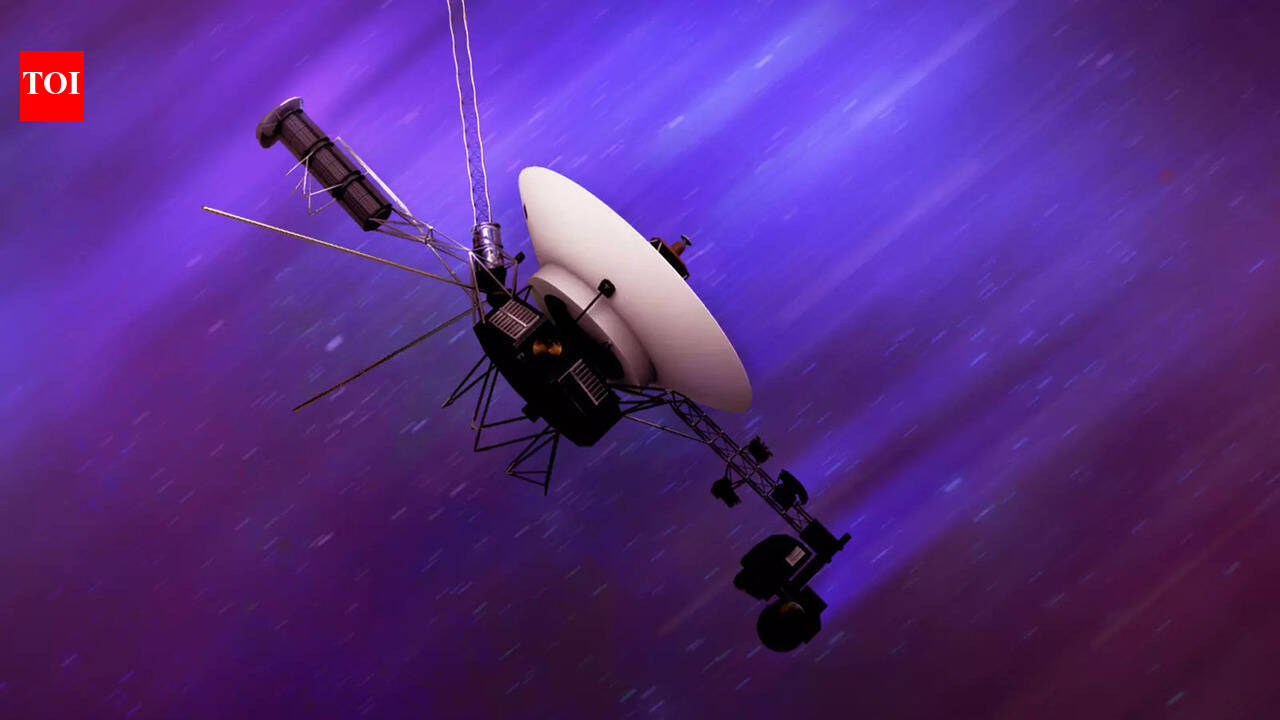
NASA’s Voyager 2 encountered Uranus during its 1986 flyby and something unusually happened then (Image Source – NASA)

Everything we know about Uranus’s radiation belts comes from one brief fly-by in 1986, when Voyager 2 passed the planet. For decades, scientists have been puzzled by what Voyager saw: Uranus had a very strong belt of high-energy electrons, but a surprisingly weak belt of ions. That combination did not make much sense.This study, “Solving the Mystery of the Electron Radiation Belt at Uranus: Leveraging Knowledge of Earth’s Radiation Belts in a Re-Examination of Voyager 2 Observations”, argues that the mystery may exist because Voyager 2 did not observe Uranus under normal conditions.Recent work shows that, during the fly-by, a large disturbance in the solar wind was hitting Uranus. This disturbance, called a corotating interaction region or CIR, is a region where fast solar wind slams into slower wind, stirring everything up.At Earth, we know these solar wind disturbances can dramatically energise radiation belts. The authors suggest the same thing happened at Uranus.

A solar wind disturbance may have supercharged Uranus during Voyager 2’s 1986 flyby

When solar wind disturbances hit a planet’s magnetic field, they can trigger powerful electromagnetic waves called chorus waves. These waves act like a cosmic accelerator. They repeatedly “kick” electrons, pushing them to extremely high energies.Voyager 2 detected the strongest chorus waves ever seen at any planet during its Uranus encounter. That matters because such waves are known, at Earth, to rapidly boost electrons to near-relativistic speeds.So the idea is simple:

  • A solar wind disturbance arrived
  • Uranus’s magnetic field responded
  • Intense chorus waves formed
  • Electrons were rapidly accelerated
  • Voyager 2 flew through this unusually active system and recorded an extreme snapshot

Ions stayed weak and didn’t respond

Ions do not respond to chorus waves the same way electrons do. So while electrons were efficiently boosted, the ion belt stayed relatively faint. That explains the long-standing mismatch between the two.

Why Uranus is special

Uranus has an extremely tilted rotation axis and a very oddly shaped magnetic field. This creates unusual and constantly changing interactions with the solar wind. That makes its radiation environment highly dynamic and hard to understand from a single fly-by.Voyager 2 may even have passed through a sparsely populated region of the magnetosphere, missing “normal” plasma conditions altogether. The strong electron radiation belt at Uranus may not be typical at all. It may reflect a temporary, storm-driven state, similar to what we see at Earth during solar wind disturbances.

Why this matters now

If this explanation is correct, then Uranus’s radiation belts follow the same basic physics as Earth’s, just in a stranger magnetic environment. But one fly-by is not enough to be sure. That is why the paper ends with a clear message: we need a dedicated Uranus orbiter to observe how its magnetosphere behaves over time, not just during a single, possibly extreme event.

Follow on Google News Follow on Flipboard
Share. Facebook Twitter Pinterest LinkedIn Tumblr Email
Previous ArticleKICL, Arsutoria sign MoU for vocational design training programme in Tamil Nadu
Next Article Beyond 1976 ban: Expert on why 50 years later, India’s ‘broken’ justice system still fails millions in bonded labour
editorial
  • Website

Related Posts

Mirabai Chanu wins India's first gold at Commonwealth Games 2026 with record lift

July 26, 2026

"I am in tears": How Taylor Swift and Travis Kelce's $2M move left families of fallen NYC heroes feeling their loved ones will never be forgotten

July 26, 2026

UP adds 46,000 new homes in six months, thousands of delayed-project buyers get relief

July 26, 2026

Pralhad Joshi takes charge as Union education minister a day after Dharmendra Pradhan's resignation

July 26, 2026

Spy scare at Nato headquarters: Canadian intern arrested in Belgium on espionage charges

July 26, 2026

Apple wants Chinese memory chips, Micron wants them blocked: How US government is caught between two American giants, and why a $250 million cheque matters

July 26, 2026
Add A Comment
Leave A Reply Cancel Reply

Economy News

Jantar Mantar was crowded, yet I breathed freely

By editorialJuly 26, 2026

It is 2015. I am in Old Delhi’s Sadar Bazar two days before Holi, speaking…

Mirabai Chanu wins India's first gold at Commonwealth Games 2026 with record lift

July 26, 2026

A diabetic’s guide to trekking: What to pack, monitor, and avoid

July 26, 2026
Top Trending

Jantar Mantar was crowded, yet I breathed freely

By editorialJuly 26, 2026

It is 2015. I am in Old Delhi’s Sadar Bazar two days…

Mirabai Chanu wins India's first gold at Commonwealth Games 2026 with record lift

By editorialJuly 26, 2026

Star weightlifter Saikhom Mirabai Chanu gave India its first gold medal at…

A diabetic’s guide to trekking: What to pack, monitor, and avoid

By editorialJuly 26, 2026

Trekking can be thrilling—fresh air, mountain views, and a break from routine.…

Subscribe to News

Get the latest sports news from NewsSite about world, sports and politics.

Facebook X (Twitter) Instagram YouTube

News

  • Education
  • Health
  • National News
  • Relationship & Wellness
  • World News
  • Politics

Company

  • Information
  • Advertising
  • Classified Ads
  • Contact Info
  • Do Not Sell Data
  • GDPR Policy
  • Media Kits

Services

  • Subscriptions
  • Customer Support
  • Bulk Packages
  • Newsletters
  • Sponsored News
  • Work With Us

Subscribe to Updates

Get the latest creative news from FooBar about art, design and business.

© Copyright Global News Bulletin.
  • Privacy Policy
  • Terms
  • Accessibility
  • Website Developed by Plenary Media Solution

Type above and press Enter to search. Press Esc to cancel.