

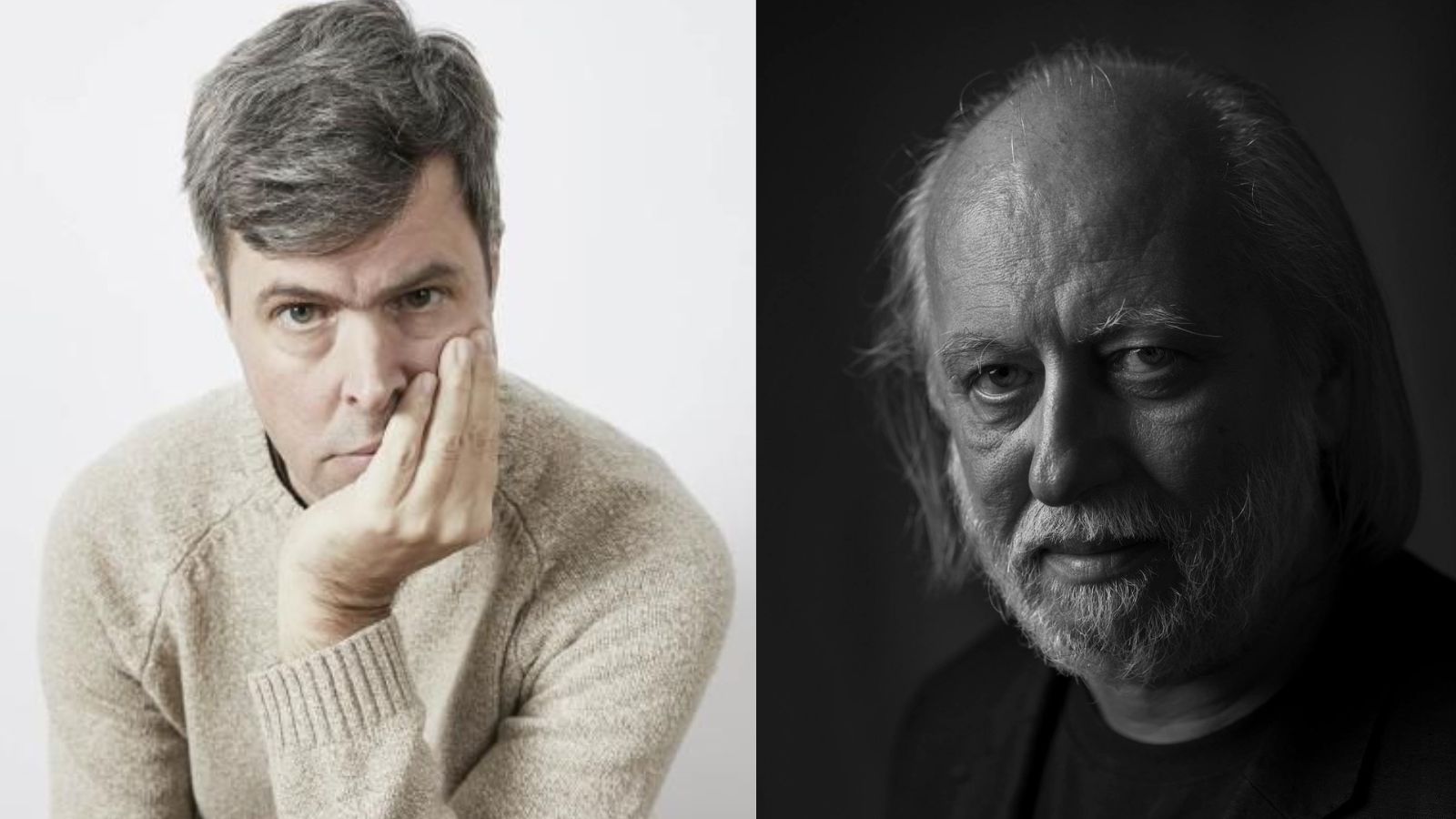
The Booker Prize 2025 Winner:In the autumn of 2025, the map of world literature has been redrawn, with its new capital situated somewhere in the imaginative landscape of Hungary. In a span of just over a month, the two most significant crowns a writer can wear, Nobel Prize in Literature and the Booker Prize, have been placed upon the brows of two authors – László Krasznahorkai and David Szalay – who are connected by a nation, yet separated by aesthetic cosmos.
Their works could hardly be more different. If Krasznahorkai is the reclusive Hungarian prophet of “apocalyptic terror,” then, Szalay is the Hungarian-British chronicler of rootless modernity. The latter was today in a glittering ceremony in London, awarded The Booker Prize for his sixth novel, Flesh. It is a long-overdue acknowledgment of a Central European sensibility that has been speaking its unsettling truths all along.

László Krasznahorkai’s labyrinth
László Krasznahorkai does not write novels so much as he constructs intricate, baroque labyrinths of language from which the reader, and perhaps the author himself, may not find an exit.
His winning the Nobel was described by the Academy as a recognition of his “compelling and visionary oeuvre,” a body of work that finds art’s power precisely where the world ends. To read Satantango or The Melancholy of Resistance is to be immersed in a prose that is itself a performance of decay and persistence; his sentences, famously long and winding, are like rivers overflowing their banks, carrying all before them in a torrent of philosophical despair and grotesque beauty.
He is the heir to Kafka and Bernhard, a writer who has stated his mission is to examine “reality to the point of madness.” His world is one of collapsing systems and eternal returns, best captured in the seven-hour, black-and-white film adaptation of Satantango by Béla Tarr, a collaboration that feels less like a translation from page to screen and more like a shared, hypnotic incantation.
 László Krasznahorkai won the Man Booker Prize in 2015, while David Szalay won it in 2025, 10 years later.
David Szalay’s precision
If Krasznahorkai is the visionary, peering into the abyss from his study, then David Szalay is his complement as the anatomist, dissecting the specimens the abyss has produced.
Szalay, who was born in Canada, raised in London, and now lives in Vienna, carries his Hungarian heritage as a central tension in his work. “Even though my father’s Hungarian, I never feel entirely at home in Hungary,” Szalay said in a video played during the ceremony. “I suppose I’m always a bit of an outsider there and living away from the UK and London for so many years, I also had a similar feeling about London, I guess. So I really wanted to write a book that stretched between Hungary and London and involved a character who was not quite at home in either place.”
Story continues below this ad
This state of unbelonging, of eternal navigation between worlds, became the engine of his Booker-winning novel.
His Booker-winning Flesh, the judges noted, is written in “spare prose,” a world away from Krasznahorkai’s dense thickets of text. It spans “from a Hungarian housing estate to the mansions of London’s rich elite,” tracing the unravelling of an “emotionally detached man.”
Fragility of the modern male psyche
This is Szalay’s great theme, the fragility of the modern male psyche, adrift in a globalised world of transaction and dislocation. Where Krasznahorkai’s characters are consumed by cosmic forces, Szalay’s are undone by the mundane failures of connection and identity. His win, for a novel written in English, is a testament to the power of the diasporic voice, one that translates the specific anxieties of a Hungarian past into the universal currency of contemporary angst.
Two poles
What, then, does this remarkable convergence signify? It is not that a single “Hungarian style” has triumphed. On the contrary, the two writers represent the opposite poles of a spectrum. Krasznahorkai’s work is deeply, almost mystically, embedded in the soil and history of his homeland, its prose rhythm feeling as ancient and inevitable as a folk tale.
Story continues below this ad
Szalay’s is fluid, transnational, and immediate. Yet together, they bookend the modern human condition. Krasznahorkai gives us the grand, terrifying prophecy of systemic collapse; Szalay provides the intimate case study of the individual who must navigate its ruins.
For the attentive reader, this autumn offers a unique opportunity. To journey from the haunting, metaphysical plains of Krasznahorkai’s Hungary to the sleek, disorienting corridors of Szalay’s Europe is to undertake a complete pilgrimage through the anxieties of our time.
That both guides now hold the highest honours in their craft is more than a celebration of individual genius. It is a signal that literature’s centre of gravity is shifting, tilting towards voices that have long understood that the end of the world is not a single event, but a series of personal, quiet apocalypses, and that within them, we might just find the power to endure.

